Saturday, June 03, 2006
Ron Rosenbaum - Explaining Hitler: The Search for the Origins of His Evil
Stephen Schlesinger - Bitter Fruit: The Story of the American Coup in Guatemala
This is the first book that really mapped out for me how American foreign policy could be hijacked by special interest groups. The usual leaps of logic and imagination required of the typcial reader of these kinds of anti-government works are there; but, not insultingly so. A very good case is made, indeed.
C. G. Jung - Modern Man in Search of a Soul
C. G. Jung - Man and His Symbols
Sigmund Freud - The Basic Writings of Sigmund Freud

Consciousness is the waves of an ocean ... Sub-consciousness is the ocean.
Paulo Freire - Pedagogy of the Oppressed

Saving the world from our present society of dominants/submissives not only saves it for the submissives ... but for the dominants, as well.
J.R.R. Tolkien - The Lord of the Rings

There's just oodles and oodles of stuff to enjoy in this story; and everyone can find a favorite scene or character in it to relate to. It really is a modern-day Bible of sorts. It speaks the same language ... only better.
Henri Pirenne - Medieval Cities
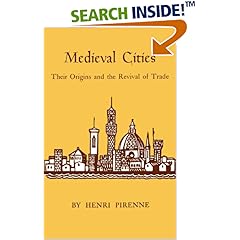
"Model of clarity"? Pirenne's sentences are simple and they progress in nice cadences, and his words are always at the service of his teaching. He has done his job as a thinker and a writer: he's distilled the thousands of pages of documents and countless hours of personal experience into a readably-sized book. This book humbly and magically made me more familiar with some of the most basic structures of society; the ones that are forever being overcomplicated and, in our time,
spun ... and that's no small accomplishment. Most books confuse; especially the more they try to amuse.
Lewis Mumford - The City in History: Its Origins, Its Transformations, and Its Prospects

Tell it like it is, Lewis baby! Mr. Mumford combines my two favorite rarest qualities in a thinker: tremendous erudition (breadth, depth, pertinency, etc.) ... and a likeable personality. This book can wow you with so many things that just make a man wonder, "How does he know all this shit?" ... while at the same time, it positively wreaks of subtle humanity. I've never read it all the way through (too big a eat) ... but I return to it every now and then ... just to take a cool dip in Lewis' clear pool of reason and decency.
Peter Gay - Freud for Historians

Nice style, again. But more than that ... a good tonic to jolt us all awake to the impoverished scope of our current knowledge of history. Mr. Gay was an historian first, and a Freudian second. And once he learned a thing or two about psychology, it changed fundamentally his way of writing his craft. This book is a kind of tentative salvo coming from the lonely corner of academia into which his intellectual honesty has boxed him. With my timeworn recollection of it, I'd highlight his notion that we can't really be serious about understanding men and events of our pasts ... not on the usual grandiose and positivistic scales ... if we can't even understand our own individual and personal pasts; the one's that are so largely submerged in the subconscious; the most important ones.
Vincent Van Gogh - The Letters of Vincent van Gogh

Vincent. Yes, I call him by his first name. Who would do otherwise after reading such personal utterances of a modest man. Vincent is endearing because he just wanted to do good. Well, he wanted much much more, as we all do ... but, as his desires bubbled up to the surface of his life, they flowed to the good ... or the seeming good, at least ... well, most of the time. Ok, so he was confused. Maybe, on second thought, it was his confusion that endeared him to me?
Peter Gay - The Enlightenment: The Rise of Modern Paganism
George Orwell - Down and Out in Paris and London

I like how Orwell (correctly) points out how some of the seemingly mindless and lowly jobs that he takes on in his crisis of poverty, are actually quite difficult. Not information that pops up in most books. Also, his writing style suits me just fine. I like how he combines a bit of literary flair with his simple no-nonsense journalistic style; and how he's ever the consumate
man. Most decent writers seem at least slightly effeminate to me. Not Orwell, he's that guy down the other end of the bar; the one that dug that hole or painted that house with you today.
George Orwell - 1984
Paul Willis - Learning to Labor
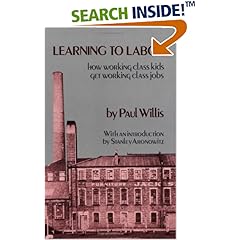
Culture is everywhere. But it's a patchwork quilt, far more than it is an elegant pyramid of hierarchical relationships all purposefully and consciously aimed at the highest culture ... the greatest good. Willis' book drove this home for me. In it I learned new ways of looking at my past; the pattern of my own blue-collar childhood. The one that still so strongly influences my ideas, for good and for ill. Willis deftly sews together the pieces of so many broken and wasted lives. Lives that he allows to speak in their own language: real people saying real things about real lives. It's a sad story, mostly ... but, there are many things said in it that make me so fondly remember the honor and the courage of the best of these people ... even if those times and those antics have been lost forever; as all cultures are mere fleeting glimpses. Maybe it's not so much a book about a *class* culture, after all. Maybe it's just about a *youth* culture? Yes, that's its underlying poignancy: all us kids gotta grow up.
C. Wright Mills - The Power Elite
Albert Camus - The Stranger
Gar Alperovitz - The Decision to Use the Atomic Bomb
Michel Foucault - Madness and Civilization: A History of Insanity in the Age of Reason
Michel Foucault - Power / Knowledge: Selected Interviews and Other Writings, 1972-1977
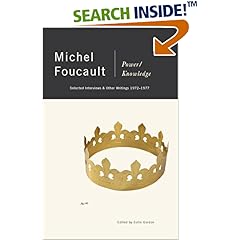
This book broke my mind open in ways that I had previously never dreamed of. It has changed my way of thinking forever. Foucault is a difficult read, but I sought him out and decided on this goody as my introduction to his ideas. It's not the best book, but in it can be found the germs of many of his most fertile contributions to our post-modern world.
Michel Foucault - Discipline and Punish: The Birth of the Prison
Michel Foucault - The History of Sexuality: An Introduction
Paul Gauguin - Noa Noa: The Tahiti Journal of Paul Gauguin
Henry David Thoreau - Walden and Other Writings
Erving Goffman - The Presentation of Self in Everyday Life
Daniel J. Boorstin - The Discoverers
Alexander Lowen - Narcissism: Denial of the True Self

The book that convinced me that I am as much a narcissist as the next guy in our society ... and that our society is narcissistic to its core. Dr. Lowen's style worked out beautifully for me; combining the right blend of sophisticated psychological theory with the simpler, less-expert clinical discussions of the problem.
Alice Miller - The Drama of the Gifted Child: The Search for the True Self
Louis A. Sass - Madness and Modernism: Insanity in the Light of Modern Art, Literature, and Thought
Noam Chomsky - Manufacturing Consent: The Political Economy of the Mass Media
Johan Huizinga - The Autumn of the Middle Ages
Hermann Hesse - Steppenwolf
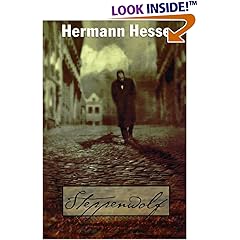
I am a steppenwolf. 'Nuff said.
David Harvey - The Condition of Postmodernity: An Enquiry into the Origins of Cultural Change
Erich Fromm - To Have or to Be

For Fromm, you can't have it both ways. That's part of the charm of his notion: you either
are a lot ... or you
have a lot. It's a psychic equation of sorts. For, if you
have a lot ... and then you want more ... and you decide that you want to
be more ... well, you can't. It's one or the other. You see, Fromm points out that you can't fool yourself into wanting to
have more
being. Being isn't something that you have, it is something that you are. There, go wrap that around your conditioned mind for a spell.
Pierre Bourdieu - Distinction: A Social Critique of the Judgement of Taste

A very influential book in my life. The book is impossible reading, but I kept at it, and learned that struggling with the style made me think more deeply and consciously about what he is saying. Bourdieu's underlying idea is simple: rich people got enough money to get good at games that poor people can't afford. We all kinda know this, but the wave of his words pounding pounding on your mind as you try to decipher his every sentence; makes you rethink and rethink ... until you have a deeper understanding of just how these games are played at all levels ... all the time. Bourdieu turns you into a fatalist ... which isn't good; but might just be a necessary condition in the fight to rip oneself out of some of the subtle traps that make up everyday life.